

Canine Exposure Surgery in Valdosta, GA
Guiding Impacted Canines Into Place With Precision and Planning
When a permanent canine tooth does not erupt on its own, timing and technique matter. At Valdosta Family Dentistry, we provide canine exposure surgery in Valdosta, GA with a highly coordinated, detail-driven approach designed to protect surrounding teeth, preserve gum health, and support successful orthodontic movement.
This is not a “one-size-fits-all” procedure. Each impacted canine behaves differently, and our role is to expose the tooth in a way that gives it the best possible chance to erupt into the correct position.
Understanding Impacted Canines and Why Exposure Is Necessary
Permanent canines play a critical role in bite stability, facial balance, and long-term tooth function. When a canine becomes trapped beneath the gumline or bone, it does not simply stay dormant.
Without proper intervention, impacted canines can:
- Push against neighboring tooth roots
- Disrupt orthodontic progress
- Create long-term bite instability
- Increase the risk of root damage or cyst formation
Canine exposure surgery is performed to preserve the natural tooth, not remove it. The goal is to carefully uncover the canine so it can be guided into alignment under controlled orthodontic force.

Need To Schedule OR Have A Question?
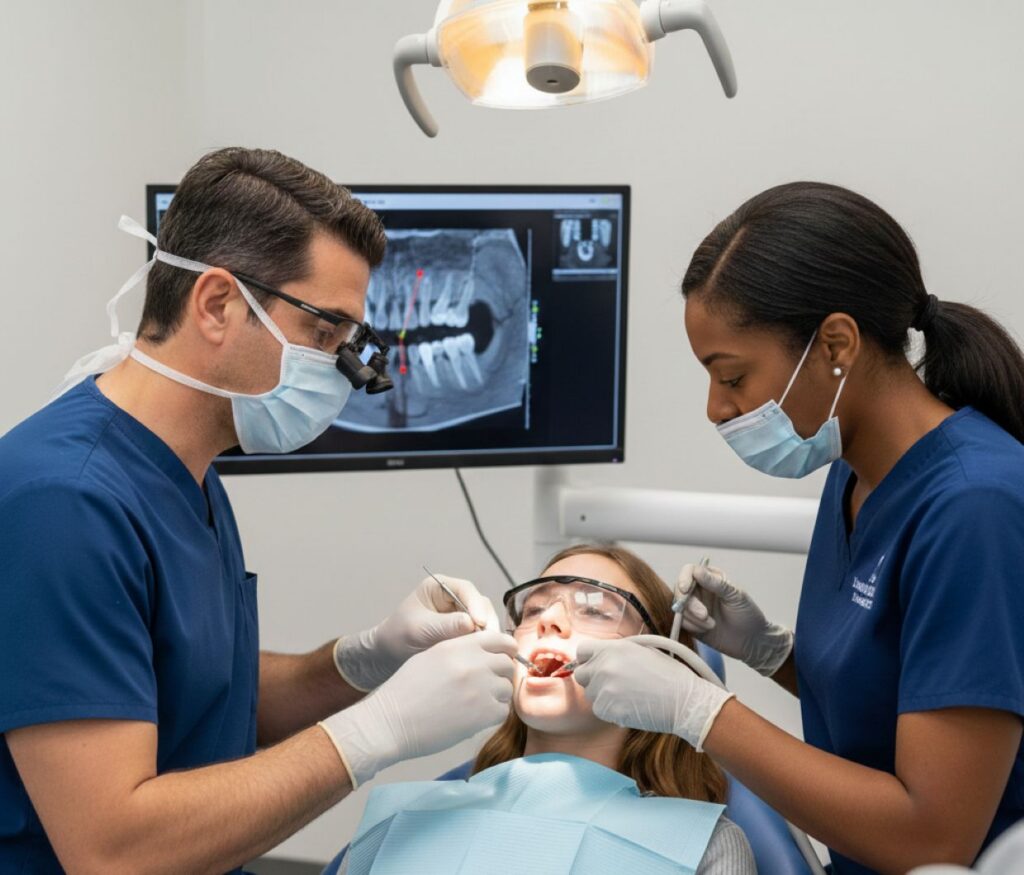
Surgical Approach: Why Technique Matters
During canine exposure surgery, we:
- Access the impacted tooth through precise tissue management
- Remove only the tissue or bone necessary to uncover the crown
- Preserve surrounding structures to support healthy eruption
- Place an orthodontic attachment when appropriate to assist guided movement
The way a canine is exposed directly affects how predictably it can be moved into place. Improper exposure can lead to gum recession, poor tooth positioning, or extended orthodontic treatment time. Our approach prioritizes long-term stability, not speed.
Coordination With Orthodontic Treatment
Canine exposure surgery is almost always part of a shared treatment plan. We work in coordination with your orthodontist to ensure:
- The timing of exposure aligns with brace placement
- The attachment method supports gradual, controlled movement
- Healing conditions allow for predictable traction
- Gum tissue remains healthy as the tooth erupts
This collaboration is essential for a successful outcome.
Who Typically Needs Canine Exposure Surgery?
This procedure is most commonly recommended for:
- Adolescents whose permanent canines have not erupted on schedule
- Patients with retained baby canines past the expected age
- Individuals whose X-rays show canines positioned high, sideways, or trapped
- Orthodontic patients whose progress is blocked by an unerupted canine
Early evaluation often reduces the complexity of treatment and improves outcomes.
Why Patients in Valdosta Choose Our Practice
We understand that surgical procedures, especially for children or teens, require trust. Our practice offers:
- A modern, state-of-the-art clinical environment
- Strict adherence to OSHA and CDC sterilization standards
- A calm, patient-first surgical experience
- Clear communication before, during, and after treatment
- Financial transparency and assistance with insurance coordination
We treat every patient with the same care we would expect for our own family.
Serving Valdosta and Surrounding Communities
Patients come to us for canine exposure surgery from:
- Valdosta
- Hahira
- Lake Park
- Moody Air Force Base
- Nearby South Georgia communities
Our local presence allows us to provide continuity of care throughout treatment.
Scheduling and Practice Information
Valdosta Family Dentistry
📍 2935 N Ashley St Ste 130, Valdosta, GA, 31602
📞 (229) 333-8484
Appointments are available for new patients, orthodontic referrals, and urgent evaluations. Emergency calls are always welcome. If extensive treatment is needed, customized payment plans are available. We accept check, cash, and major credit cards.
Frequently Asked Questions About Canine Exposure Surgery
Is canine exposure surgery always necessary for impacted canines?
Not always. In some cases, early orthodontic intervention alone can encourage eruption. Surgery is recommended when imaging shows the canine is unlikely to erupt without assistance or poses a risk to nearby teeth.
Does the procedure remove the tooth?
No. Canine exposure surgery is performed to preserve the natural tooth. Extraction is considered only when the tooth cannot be safely positioned.
How long does it take for the canine to move into place after surgery?
Movement timing varies. Some canines begin responding within weeks, while others take several months depending on position, age, and orthodontic forces used.
Will the exposed tooth look noticeable right away?
Typically no. The tooth is gradually guided into position over time. The exposure itself is discreet and managed carefully to maintain a natural gumline.
Is this procedure appropriate for adults?
Yes. While earlier treatment often simplifies the process, adults can still benefit from canine exposure surgery when properly planned and coordinated with orthodontic care.
Take the Next Step
If you or your child has been told a canine is impacted or orthodontic treatment has stalled, early evaluation matters. Call (229) 333-8484 to schedule a consultation for canine exposure surgery in Valdosta, GA, and get clear, professional guidance on the best path forward.