

Dental Bridges in Valdosta GA
Restoring Missing Teeth with Precision, Stability, and Long-Term Planning
Replacing missing teeth is not just about closing a gap. Tooth loss alters how forces move through your bite, how neighboring teeth function, and how surrounding bone responds over time. Dental bridges in Valdosta GA are a fixed restorative solution designed to replace missing teeth while restoring bite stability, chewing efficiency, and long-term oral balance.
At Valdosta Family Dentistry, dental bridges are planned using restorative and biomechanical principles that prioritize durability, comfort, and protection of your remaining natural teeth.
What a Dental Bridge Is Designed to Accomplish
A dental bridge is a fixed prosthetic restoration that replaces one or more missing teeth by redistributing chewing forces across supporting structures. It is engineered to work as part of the overall bite system. A bridge includes:
- Pontics, which replace missing teeth and restore chewing surfaces
- Abutments, which may be natural teeth or dental implants that anchor the bridge

Need To Schedule OR Have A Question?
Beyond appearance, a well-designed bridge restores:
- Balanced chewing forces
- Proper contact between opposing teeth
- Stability of surrounding teeth
- Facial support and lip posture
- Speech patterns affected by missing teeth
A bridge that is not properly designed can overload supporting teeth or compromise long-term oral health, which is why planning and experience matter.
Why Untreated Tooth Gaps Create Progressive Problems
When a tooth is lost and not replaced, changes begin almost immediately. These changes often go unnoticed until secondary problems appear. Over time, missing teeth can lead to:
- Tilting or drifting of adjacent teeth into the open space
- Over-eruption of opposing teeth due to lack of contact
- Uneven bite forces that accelerate enamel wear
- Increased stress on remaining teeth and jaw joints
- Difficulty chewing efficiently, especially fibrous or firm foods
- Progressive bone loss beneath the missing tooth
Dental bridges interrupt this chain reaction by restoring continuity within the dental arch and stabilizing bite mechanics.
Types of Dental Bridges and the Clinical Logic Behind Each Choice
Traditional Fixed Dental Bridges
Traditional bridges are supported by crowns placed on natural teeth adjacent to the missing space.
They are typically recommended when:
- Adjacent teeth already have large restorations or structural compromise
- Supporting teeth have sufficient root support and bone stability
- Bite forces can be evenly distributed across abutment teeth
This option allows predictable function when abutment teeth are strong and properly positioned.
Implant-Supported Dental Bridges
Implant-supported bridges rely on dental implants rather than natural teeth for support. They are often recommended when:
- Adjacent teeth are healthy and should not be altered
- Multiple teeth are missing consecutively
- Bone quality allows implant placement
This design preserves natural teeth and provides strong structural support, especially for larger spans.
Cantilever Dental Bridges
Cantilever bridges are supported on only one side of the missing tooth. They are used selectively when:
- Bite forces are minimal
- Tooth position allows controlled loading
- Other options are not feasible
Because of increased mechanical demands, cantilever bridges require careful planning and are not appropriate in all cases.
How We Determine Whether a Dental Bridge Is the Right Solution
Health of Supporting Teeth
We assess enamel integrity, root length, bone support, and existing restorations on potential abutment teeth. Supporting teeth must tolerate added load without increased fracture risk.
Bite Analysis and Force Distribution
A bridge must be designed to avoid excessive pressure on any single tooth. We evaluate how your teeth come together during chewing and resting positions.
Gum and Bone Stability
Healthy gums and stable bone are essential. Inflammation or untreated periodontal disease can compromise bridge longevity.
Comparison with Alternative Treatments
We discuss bridges alongside dental implants and removable partial dentures so patients understand advantages, limitations, and long-term considerations of each option.
The Dental Bridge Process at Valdosta Family Dentistry
Diagnostic Planning
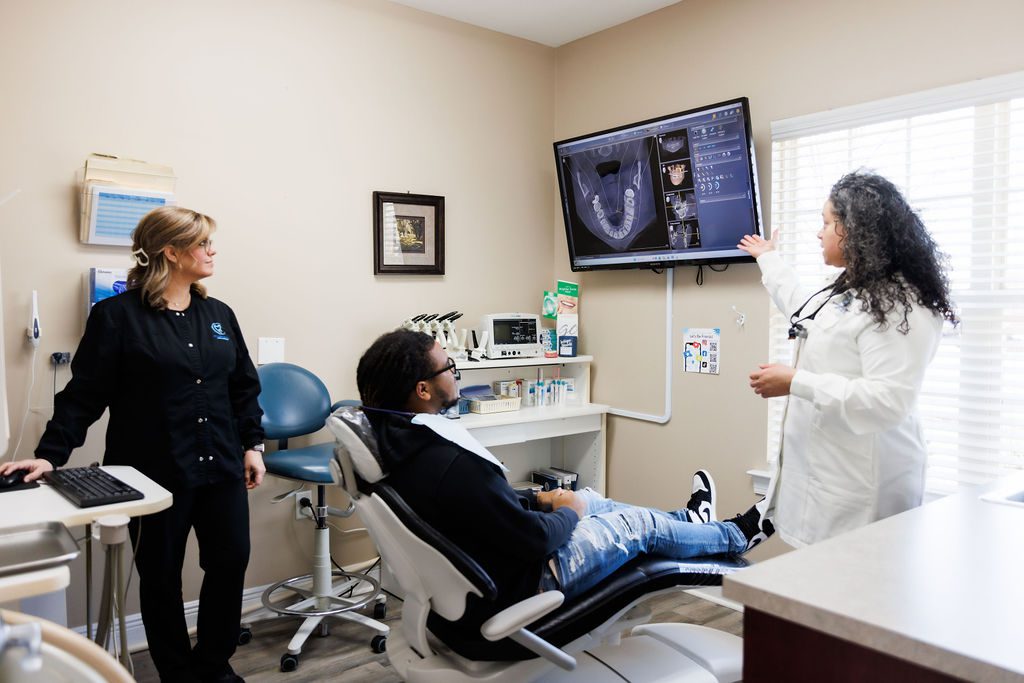
We begin with a thorough exam and dental imaging to assess spacing, alignment, and bite dynamics. This information guides design decisions before any tooth preparation occurs.
Preparation of Supporting Teeth
When natural teeth support the bridge, they are carefully reshaped to allow proper crown retention while preserving as much healthy structure as possible.
High-Precision Impressions or Digital Scans
Accurate records are essential for marginal fit, bite accuracy, and esthetic integration. These records guide laboratory fabrication.
Temporary Protection Phase
Temporary restorations protect prepared teeth, maintain spacing, and allow patients to function comfortably while the final bridge is crafted.
Final Bridge Placement and Bite Calibration
We verify marginal fit, contact points, and bite balance. Adjustments are made to ensure even force distribution and comfort before final cementation.
Ongoing Monitoring
Routine visits allow us to monitor the bridge, supporting teeth, and surrounding tissues over time.
Technical Advantages of a Properly Designed Dental Bridge
Controlled Force Distribution
A bridge spreads chewing forces across multiple supports rather than concentrating stress on a single tooth.
Bite Stabilization
Replacing missing teeth helps maintain vertical dimension and prevents bite collapse.
Protection of Adjacent Teeth
Proper spacing prevents unwanted tooth movement and reduces the risk of future orthodontic or restorative issues.
Predictable Daily Function
Fixed bridges allow confident chewing and speaking without the movement associated with removable appliances.
Natural Appearance
Modern materials allow precise shade matching and contouring for seamless integration with surrounding teeth.
Dental Bridges for Patients in Valdosta and Surrounding Areas
We provide dental bridge treatment for patients across Valdosta and Lowndes County, including Hahira, Lake Park, Remerton, and nearby South Georgia communities. Receiving restorative care locally allows:
- Easier follow-up and adjustments
- Continuous monitoring of supporting teeth
- Faster response if discomfort or damage occurs
- Long-term planning with the same care team
Local continuity improves outcomes and patient confidence.
Why Patients Trust Valdosta Family Dentistry for Dental Bridges
Experience in Complex Restorative Planning
Dental bridges require understanding of occlusion, material behavior, and load management. Our approach focuses on structural longevity, not short-term fixes.
Conservative Tooth Preservation
We avoid unnecessary removal of healthy tooth structure whenever possible and plan restorations that support long-term tooth survival.
Precision Fabrication Standards
We partner with dental laboratories that prioritize marginal accuracy, strength, and esthetic realism.
Integrated Treatment Perspective
We consider how bridges interact with future dental needs, including implants, periodontal care, and bite changes over time.
Transparent Patient Communication
Patients receive clear explanations of expected lifespan, maintenance needs, and alternative options.
Commitment to Safety and Cleanliness
Our office meets and exceeds OSHA and CDC infection control standards, providing a safe and comfortable treatment environment.
Long-Term Care and Maintenance of a Dental Bridge
To protect your bridge and supporting teeth, we recommend:
- Thorough brushing along the gumline
- Flossing beneath the pontic using floss threaders or interdental brushes
- Routine professional cleanings
- Avoiding excessive force from hard objects like ice
- Prompt evaluation if looseness or discomfort occurs
Consistent maintenance significantly extends bridge longevity.
Common Questions About Dental Bridges
How long do dental bridges typically last
With proper care and stable supporting teeth, many bridges last well over ten years.
Will a dental bridge feel natural
Most patients adapt quickly once bite balance is finalized.
Can a dental bridge be repaired if damaged
Minor issues may be repairable. Significant damage often requires replacement to maintain structural integrity.
Are dental bridges better than implants
Neither option is universally superior. The best choice depends on anatomy, health, and long-term goals.
Does insurance usually help cover dental bridges
Many plans offer partial coverage. We review benefits and provide clear cost estimates before treatment.
Schedule a Dental Bridge Consultation in Valdosta GA
If you are missing teeth and want a fixed, reliable solution, a dental bridge may be the right option.
Valdosta Family Dentistry
📍 2935 N Ashley St Ste 130, Valdosta, GA, 31602
📞 (229) 333-8484
Schedule a consultation to discuss your options and receive a personalized restorative plan.