
Yes. Some patients can get dental implants without bone grafting when there’s enough healthy bone in the right place to support the planned implant. Others may need a graft during implant placement or before it. The decision depends on what the dentist finds at the specific site where the implant would go.
Two people can have a gap in the same part of the mouth and receive different recommendations. One may have enough bone to place an implant where it needs to sit for the final crown. The other may have plenty of bone height but too little width at that spot. An exam and appropriate imaging help the dentist explain what makes the difference.
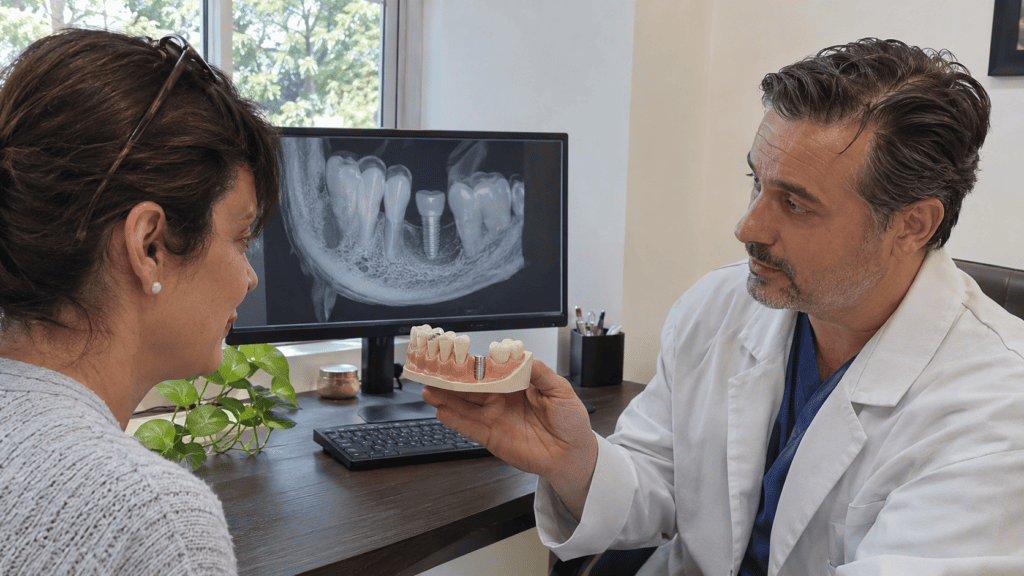
What Does the Dentist Look for on the Exam and 3D Scan?
An implant is a post that sits in the jawbone and supports a replacement tooth. The dentist considers where the crown will sit, how it will fit with your bite, and where the post needs to go to support it. That’s why the plan starts with the tooth you want to replace and the bone available at that exact location.
At the exam, the dentist checks the gums, nearby teeth, and the shape of the jaw where the tooth is missing. They may ask when the tooth was removed, whether you’ve had gum disease or an infection in the area, and whether grafting was done at the time of extraction. Bone can change after a tooth is removed, but the length of time it’s been missing doesn’t tell the dentist how much support remains.
3D dental imaging, also called cone beam computed tomography or CBCT, lets the dentist look at the bone from several angles. During implant planning, it can help show the following:
| What the dentist checks | How it may affect treatment |
| Bone width: Is the ridge wide enough where the post needs to sit? | A narrow ridge may need additional bone even if it has enough height. |
| Bone height: How much room is available above a nerve or below the sinus, depending on the site? | Limited height may affect the implant choice or whether the area needs preparation first. |
| Bone around the planned implant: Is there enough support in the position that makes sense for the final crown? | If the bone is thin or missing on one side, the dentist may need to modify the plan or recommend a graft. |
The scan helps the dentist assess the site. They interpret it alongside the exam and the plan for the replacement tooth. A number on the scan alone doesn’t tell you whether grafting is needed. At your appointment, ask your dentist to show you where the implant would sit and point out any area that may need more support.
What Are the Three Possible Treatment Paths?
1. Implant Placement Without a Graft
If the bone at the planned site has suitable dimensions and can provide a stable foundation, the dentist may be able to place the implant without adding graft material. The gums and the rest of your oral health also matter. For example, active gum disease may need treatment before placement, even when the bone at the site appears adequate.
2. A Graft During Implant Placement
In selected cases, existing bone can hold the implant securely when it’s placed, but one area around it still needs more support or a better contour. The dentist may place the implant and add graft material during the same procedure. This is why same-day implant placement can still involve grafting. Whether a temporary or final tooth can be attached is a separate decision. Valdosta’s guide to same-day implant placement explains that timing in more detail.
3. A Graft Before Implant Placement
If the site can’t support the implant in the planned position, the dentist may recommend bone grafting first. One example is a ridge that is too narrow to hold the planned implant. A procedure called ridge augmentation may use graft material to rebuild part of that ridge. The dentist checks how the site heals before deciding when to proceed. Ask what they need to see at follow-up and what you can use to replace the tooth in the meantime, if needed.
What If the Tooth Hasn’t Been Removed Yet?
If an extraction is planned, bring up your interest in an implant before the tooth comes out. Your dentist can explain what they expect to find around the root and what they’ll check after the tooth is removed. Ask whether the plan is to place the implant that day, let the area heal, or consider a graft at the time of extraction to help preserve the shape of the ridge. A graft placed in an empty socket can be part of preparing the site for a future implant. It doesn’t tell you on its own when the site will be ready.
If you’ve already had a graft at the site, tell the dentist when and where it was done. Bring any relevant records or images you have. The dentist can review those alongside the current exam to see what has changed and whether the ridge is ready for the implant that would support your replacement tooth.
Can a Smaller Implant Change the Recommendation?
Implant size and design are part of planning. For example, mini dental implants may help stabilize certain dentures. They still need adequate bone for support, and the forces on an implant that holds a denture can differ from those on a post supporting a single crown. The dentist considers what the implant will support and where it needs to sit before recommending a design. A smaller implant doesn’t automatically make every site suitable.
What Should You Ask at Your Implant Consultation?
If you’ve been told you need a graft, ask what the graft would do in your case. It might rebuild a narrow ridge before placement or address a smaller area around an implant that can already be held by existing bone. Knowing the purpose helps you understand why another step may be recommended and what it means for your schedule.
- Can you show me where the replacement tooth and implant would go?
- Which finding is driving the recommendation: width, height, the condition of the surrounding bone, or something else?
- If I need a graft, can it be placed with the implant, or does it need to heal first?
- What will you check before moving to the next step? What other tooth replacement options can I consider?
FAQs
If I need a graft on one side, will I need one at every implant site?
Not necessarily. Each site has its own shape, amount of bone, and nearby structures. The dentist may recommend different treatment steps for different areas in the same mouth.
Can the plan change after a tooth is removed?
Yes. The dentist may learn more about the condition of the socket or how securely an implant could be held once the tooth is out. Ask what the backup plan would be if the findings differ from what the exam and scan showed.
Does a tooth that’s been missing for years always need a graft?
No. Bone may change over time after tooth loss, but those changes vary from person to person. How long the tooth has been missing is useful history. The decision depends on the bone and other findings at the site today.
How long will I wait for an implant if grafting comes first?
There is no single timeline. Healing depends on the location, the amount of grafting, and how the area responds. Your dentist can explain what they will check at follow-up and when they expect to reassess the site for implant placement.
If you’re deciding whether to replace a missing tooth with an implant, request an implant consultation with Valdosta Family Dentistry in Valdosta, Georgia. We’ll evaluate the site, review what the findings mean, and explain whether a graft may be part of your plan.